

During a Zoom hang with two friends in different time zones we shared life updates and talked shit about people whilst eating forkfuls of our respected Pepperidge Farm cakes (yes, we planned it). As we chuckled and reminisced, then we started to talk about our age. Being all of the same age range, the conversation led to one of my friends saying, “I’m not afraid to die, I am just scared of all that stuff leading to that” and for a split second, the mood shifted. It was a moment where we collectively realized, “Wow, we’re in our 40s.”
Yes, the 40s aren’t what they were 20 years ago. Hell, it isn’t what it was in the 20th century… and the fact that I can say that speaks to where I am coming from. I love saying how I am 45 years old until my doctor points out it’s time for a colonoscopy. Listen, I love the fact that I grew up in my formative years without social media and the deluge of internet malarkey. I like to wear that as a badge of honor. But that badge of honor can be immediately stripped when someone in their 20s reminds you — whether it is intentionally or unintentionally — that you are… old.
Aaliyah was kind of right when she sang “Age Ain’t Nothing But a Number”, but it’s a figure that will forever exist and hold a universal truth no matter how we look at it.
When I was reading Jon M. Chu‘s Viewfinder: A Memoir of Seeing and Being Seen, I thought it was going to be a retrospective of his film career — a film career I absolutely love because it started with Step Up 2: The Streets. While reading it, I didn’t realize that Chu and I were born in the same year. Granted, I am a couple of months older, but we were both born in the same year which gave us some of the most iconic movies including Alien, Mad Max, The Jerk, The Warriors, and Monty Python’s Life of Brian.
It’s clear that Chu and I chose different career paths and were born in different environments — he in Silicon Valley and me in San Antonio, Texas, but even so, I compared my career path to his. In 2008, he released Step Up 2: The Streets while I was teaching fashion journalism at the Academy of Art University in San Francisco. But part of me was jealous. I was thinking, I could have followed a similar path. I hear Sheryl Lee Ralph’s character in Sister Act 2: Back in the Habit telling me: “There are a lot of talented people right down there on the streets singing their shoulda’, coulda‘, woulda’s…”
When I read books, I love to tag, dogear, take notes, and highlight. Sometimes I’ll do an eBook or an audiobook but while reading an actual, physical book I get so excited so I can use my fun 3M index tabs. I used a lot of them for Viewfinder.

You’d think I’m doing book report on Viewfinder — which I am.
* * * *
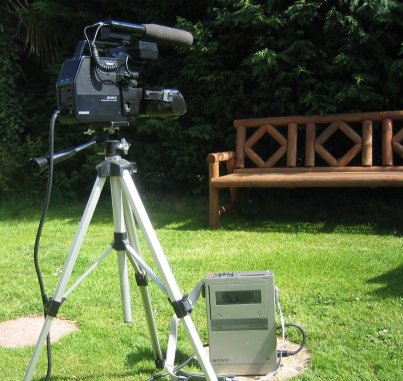
Like Chu, I was once an aspiring filmmaker. I thought I was going to make movies one day. And as Chu mentions in his memoir, I would teach myself the “hi-fi” technology of the time. I would use my dad’s camcorder — the kind where you would have to carry the VCR in a tote on your shoulder — to create movies for school projects. The camcorder kinda looked like this.
During my junior year in high school, my parents gifted me an RCA camcorder (I still have it, but it’s on its last legs) and I went wild, filming so many stupid things with my friends including band trips, choir trips, competitions, and video scavenger hunts in malls. We were all in choir and/or band together and it was the ’90s so that automatically made us weirdos. My obsession with using my camcorder to capture Real World moments would continue well into college at Texas Tech and then Texas A&M where I started to collect footage from my college experience primarily through the lens of me being the Philippine Student Association president.
The dreams of becoming of filmmaker were never really shot down, but I didn’t feel that it was realistic for me. Part of me wonders if I would have been more inclined to become a filmmaker if there were more Asian — or even more POC filmmakers during my “director era”. But alas, that is another multiverse.
Having lived in the Bay Area for a decade after my time in Texas made me familiar with Chu’s Los Altos and Silicon Valley references. One of the things that made me a little envious was that Chu’s parents were, for the most part, supportive of his artistic endeavors.
I hate the narrative of Asian parents pushing their kids to be doctors, lawyers, or entering a more stable profession. You would think by now Asian parents would be more open, and although they are, I still hear this tired pushback that feels exhaustingly archaic.
I started as pre-med my first semester at Texas Tech University until I eventually realized I hated chemistry and found my way to journalism at Texas A&M — a decision that wasn’t rejected by my parents. They just didn’t understand that I wanted to be the next great entertainment writer. In all honesty, I had no idea what that meant, but I liked pop culture and entertainment and I wanted to write about it all. I was leaning more towards fashion journalism, but I wrote plenty of cool articles for the A&M newspaper, The Battalion, including my most memorable work there: an interview with the late Fresh Kid Ice of 2 Live Crew.

(I took full advantage of those Papa John’s deals back in the day. It was before all those scandals came to light.)
Even though I had a paying job at The Battalion (I was getting paid $5 per review and $15 per feature!), my parents still couldn’t see journalism as a viable career. It wasn’t until I rebranded it as “mass communications“. had no idea what a “mass communications” person does, but they were a little more accepting of that. Also, I am the youngest of the family so they were just exhausted by me at this point. So they just released me to become the journalist I was meant to be — which took forever and is probably still happening.
I was also obsessed with the Step Up franchise which brings us back to Viewfinder. (I swear, I have a point to this long-ass “compare and contrast” essay between me and Jon M. Chu.) His first studio feature film was the sequel Step Up 2: The Streets and he went on to do Step Up 3D in 2010. He also launched the series The Legion of Extraordinary Dancers (LXD) in the early days of Hulu which spoke to Chu’s brand of pop-infused storytelling. He collaborated with LXD choreographer and future Crazy Rich Asians actor Harry Shum Jr. LXD was also a continuing working relationship with choreographer Christopher Scott, who worked with Chu on the Step Up movies and more recently, on In the Heights. Reading the book reminded me that I once interviewed Scott and the late, great Stephen “tWitch” Boss when they came through San Francisco for the Step Up: Revolution press tour in 2012, an installment for which Chu had an executive producer credit.

(Scott insisted that we do a B-boy stance in the above photo. I tried my best — and that waist was snatched back in 2012, wasn’t it?)
Nonetheless, Chu’s pop movie approach worked. He became the go-to guy for all things pop, going on to direct two Justin Bieber documentaries as well as popcorn titles like Now You See Me 2 and G.I. Joe Retaliation. But it was his Jem and the Holograms misstep that helped him get on track.
The adaption for Jem seemed like a surefire win for Chu, combining pop music, nostalgia, and technology. But there was no “Showtime Synergy!” excitement for the film as the film was a financial and critical bomb — something Chu talks at length about in the book. He even includes how he felt during this keynote speech at the Film Independent Forum in 2015, which was shortly after Jem‘s opening weekend.
Chu admits that he tried to make Jem too earnest and that took away from the outlandish fun that made fans fall in love with the animated series.
But alas, sometimes failing is a good thing because it either tells you where to go next.
You can’t deny the TRL energy from the early ’00s that is infused in Chu’s work. There is this infectious flashy “HOLLYWOOD!” energy that is amped up and that saturates the screen. He gives you the Hollywood fantasy whether you want it or not. This all can be traced back to Chu’s Silent Beats, an award-winning short he made in college using the format of pop songs of the era.
“When the young man arrives at the store, it is like the opening of a song: The energy builds. The verse is when he walks through the aisles, as the other two characters dart glances at him, their minds flashing to their preconceived notions of who he is — as he does the same to them. As he approaches the counter, the rhythm slows down the way a Max Martin-produced hit does. When he comes face-to-face with the store owner — the tension between them mounting, like a showdown in a western — the rhythm erupts again, like an out-chorus.”
Sure, it may be a little softball by today’s standards, but surprisingly, not many people had the opportunity to showcase storytelling like this. Social media was non-existent. In essence, Chu was a “content creator” before the label “content creator” was even coined. It spoke to his Silicon Valley wiles.
But Chu is not just a simple content creator. He has continued to infuse this “let’s have some goddam fun like it’s the last day of school” pop music energy that just thrives in the spaces he creates. We saw it in Silent Beats as much as we see it on an epic scale in the “96,000” number in In the Heights.
And of course, we see his pop style in the aforementioned Crazy Rich Asians, a movie that was groundbreaking and something that Chu speaks to in the book in great detail. It was a moment for the AAPI community and I tried my best to support it when it came out in 2018.
While at Deadline, my New Hollywood co-host Amanda N’Duka and I were more than happy to welcome Crazy Rich Asians stars Jimmy O. Yang, Nico Santos, Henry Golding, and even the great Michelle Yeoh on our podcast. I also interviewed Chu for a more in-depth article about AAPI representation. (Chu would later be a New Hollywood guest for In the Heights with Lin Manuel Miranda) I even remember feeling that it was definitely a “moment” for the community… but I also proceeded with caution because, you know, Hollywood was going to be Hollywood.
At the time of release, Crazy Rich Asians became the highest-grossing rom-com in nearly a decade. It bolstered the careers of Adele Lim who would go on to write Raya and the Last Dragon and Joy Ride. It also amplified the cast: Golding, Yang, Santos, Yeoh, Constance Wu, Gemma Chan, Awkwafina, Chris Pang, Ronny Chieng, Sonoya Mizuno, Remy Hii, and Ken Jeong.
After the dust settled from the excitement of Crazy Rich Asians, the criticism within pockets of the AAPI community started to bubble up. I heard many South Asian people talk about the lack of South Asians in the movie (Chu talks about this in the book). I also had my criticisms of “representation” in the movie. Santos, a queer Filipino actor, wasn’t blatantly Filipino in the movie. Even the title suggests something that limits not-so-rich Asian audiences and many people had problems with the word “crazy”.
There will always be naysayers — and I am one of them sometimes. I see myself more as a skeptic than a hater. But at the end of the day,Crazy Rich Asians did what it needed to do despite my over-policed, splitting hairs view of representation.
* * * *
In Viewfinder, Chu recounts being in college at USC and trying to find “his people” in a pre-social media era. He admitted to burying his Asianness (I think a lot of people of our generation did at one point or another) and sizing up other Asians who infiltrated his friend group. “It was mostly me silently saying, I worked really hard to get here so don’t screw this up for me,” Chu writes. He continues:
“At least, that’s how my predicament looks in retrospect. I wasn’t conscious about my motivations at the time, and I sure never talked about them. Which was a big part of the problem. I felt so alone.”
That hit close to home for me — and it was why I tried to hyper-assimilate my first year at Texas A&M University (and before that Texas Tech). I wanted to be that Asian friend. And in all honesty, I wanted to be white-accepted and A&M and Tech were two of the whitest universities in Texas at the time.
At one point, I almost joined a Christian fraternity and when that went south, I took up smoking cigarettes. And I will be totally honest: when I read that Chu went Christian for a minute and also picked up smoking during his identity-searching college years, I was like, “BITCH STOLE MY LOOK!” And let me take a moment to recognize how he talked about smoking weed and saw a flash-forward of his family life with his kids, something he used to help inform how he approached In the Heights. (If Jon M. Chu wants to be a guest on The Green Room, he is more than welcome.)
While reading Viewfinder, I kind of mourned what could have been with my “filmmaking career”. When I started doing that, I went on this downward spiral of “How can Jon M. Chu and I be the same age and I still live in a two-bedroom apartment with a roommate who I never talk to?” I also began to see names of people in the book who I work closely with and the brat (not the good kind) started to emerge, My mid-life crisis came front and center as I read about his next project: Wicked, which felt like one of his ultimate goals from the moment he saw the original musical in San Francisco.
I started to think and beat myself up. I thought that all these people were passing me by as I go through my mid-life crisis singing my coulda, shoulda, woulda’s. “WHERE IS MY WICKED? WHEN IS IT MY TURN?”
At this point, it became less about age and more about “compare culture” — and that mixed with the film and TV industry is a recipe for disaster for your mental health.
Compare culture is an epidemic and social media has amplified the insatiable and unhealthy appetite to reach unrealistic goals. Confine that vibe into a marginalized community and it has the tendency to become a cesspool of crab mentality… and that’s not fun.
Many people in the AAPI community approached Crazy Rich Asians and Chu’s work in general with this “sizing up” attitude that he mentioned in the book. I think we all do that because many of us were programmed to live in a scarcity mindset which will eventually lead to an implosion. It’s the Highlander syndrome: “There can only be one”.
Chu goes on to write about Asians infiltrating his mostly non-Asian friend circles: “If we had been open about what we were feeling, we could have helped each other. It would have been a lot healthier than competing for what we thought was the one available slot for the Asian friend.”
Sure, Crazy Rich Asians was a very East Asian story, but if anything, it broke open storytelling possibilities. “It’s unfair for one movie to represent all these people,” Chu told me in my 2018 Deadline interview. “One movie that represents [all] Asians — that’s just ridiculous. However, if this can crack the door a little bit so that other stories can be told, and it spawns a resurgence in these stories getting shown at the highest levels possible — I would love to have this.”

(The above pic of the Crazy Rich Asians cast and the Black Panther cast, Mike Myers and some other white men at SAG Awards in 2019 was iconic)
Fast forward to today, and Chu still seems to be that Silent Beats filmmaker. When it comes to Crazy Rich Asians he says in his book, “I’ll always be proud of the movie, but I know that it has done its work. It has nothing to do with the next phase of the fight to change the way people see Asian Americans. In this phase, the challenge isn’t about representation, about how people depict us. It’s about self-presentation — the way we choose to depict ourselves.”
Chu and I are the same age, but I don’t have Hollywood power attached to my name nor have I “made it” — and my mid-life crisis reminded me of that. But Jon’s book reminded me that I am exactly where I need to be.
… but I can’t help but think what could have been with my filmmaking career. (P.S. I have never shared this video with anyone besides friends because you’ll see why.)